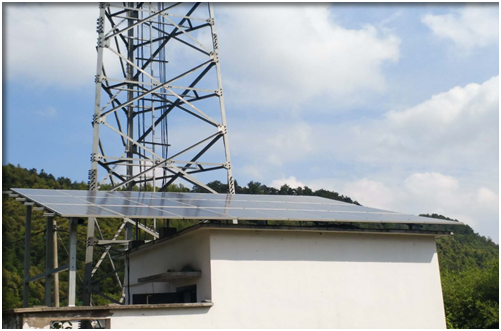
I. Project Overview
This project is a high-reliability off-grid energy system designed for scenarios without stable grid access or with demanding power quality requirements. Through a “PV + energy storage + diesel generator” multi-energy complementary architecture, it achieves 7×24 hour uninterrupted power supply for 5kW critical loads. The system adopts a DC bus architecture to improve energy efficiency, with a diesel generator serving as backup power for extended periods of cloudy or rainy weather. It is suitable for harsh environments such as communication base stations, border outposts, remote mining sites, and scientific research observation stations.
II. System Architecture & Energy Flow Design
1. PV Power Generation Unit
Equipped with 21kW high-efficiency monocrystalline modules, with average daily power generation of approximately 60–90 kWh (depending on sunlight conditions);
Supports MPPT optimization, adapting to complex lighting environments.
2. Energy Storage System
120kWh lithium iron phosphate battery, supporting ≥ 6,000 cycles (@80% DoD);
Connects directly to the DC bus via a DC-DC converter, reducing conversion losses;
Can independently support a 5kW load for approximately 20 hours of continuous operation.
3. Diesel Generator Assistance
Serves as long-duration backup power, automatically starting only when the battery level falls below a set threshold and PV generation is insufficient;
Equipped with an intelligent start-stop controller, reducing no-load losses and maintenance costs;
Supports emergency charging of the battery bank.
4. DC-DC Power System
Achieves efficient DC coupling between PV, battery, generator, and loads;
Conversion efficiency ≥ 97%, reducing overall system energy consumption.
III. Operation Strategy & Intelligent Management
PV Priority Mode
During the day, PV directly powers the load, with excess energy stored in the battery;
Battery level is maintained between 40%–90% to extend service life.
Storage Dominant Mode
At night or on cloudy days, the battery supplies power with seamless switching;
Load power is dynamically regulated to avoid battery over-discharge.
Generator Backup Mode
When the battery level falls below 30% and PV generation is insufficient, the generator automatically starts;
The generator simultaneously powers the load and charges the battery, then stops once the battery reaches 60%.
Multi-Source Coordinated Control
The EMS system enables intelligent dispatch of three energy sources: PV, battery, and generator;
Supports remote start/stop, mode switching, and fault diagnosis.
IV. Core Advantages
✅ High Reliability
Triple power supply guarantees ensure critical loads remain powered;
DC architecture reduces points of failure, improving system robustness.
✅ High Efficiency & Energy Saving
Direct DC supply reduces AC/DC conversion losses, improving overall system efficiency by 5%–8%;
Intelligent generator start-stop reduces fuel consumption by more than 30%.
✅ Long-Life Design
LiFePO₄ batteries combined with intelligent charge/discharge strategies extend system service life;
Generator operates on demand, reducing cumulative operating hours.
✅ Strong Environmental Adaptability
The system operates stably within a wide temperature range of -30°C to 50°C;
IP55 protection rating, suitable for high-altitude, high-humidity, and dusty environments.
V. Typical Application Scenarios
Communication Base Stations / Border Outposts: Ensure uninterrupted operation of communication equipment and monitoring systems;
Remote Mining Sites / Exploration Camps: Provide power for operational equipment and living facilities;
Islands / Nature Reserves: Achieve off-grid power supply primarily from green energy, supplemented by diesel;
Emergency Command Centers: Serve as disaster backup power systems, enhancing emergency response capability.
VI. UNIWEALTH Value Contribution
Self-Developed BMS & EMS Systems: Enable multi-energy coordination and full battery lifecycle management;
DC System Integration Experience: DC coupling architecture has been applied in multiple off-grid projects;
Global Service Network: Provides remote monitoring and local technical support, ensuring long-term stable system operation.